Invisible Braces for Adults: What to Expect
junio 10, 2026
Invisalign or Brackets: Which Is Better?
junio 12, 2026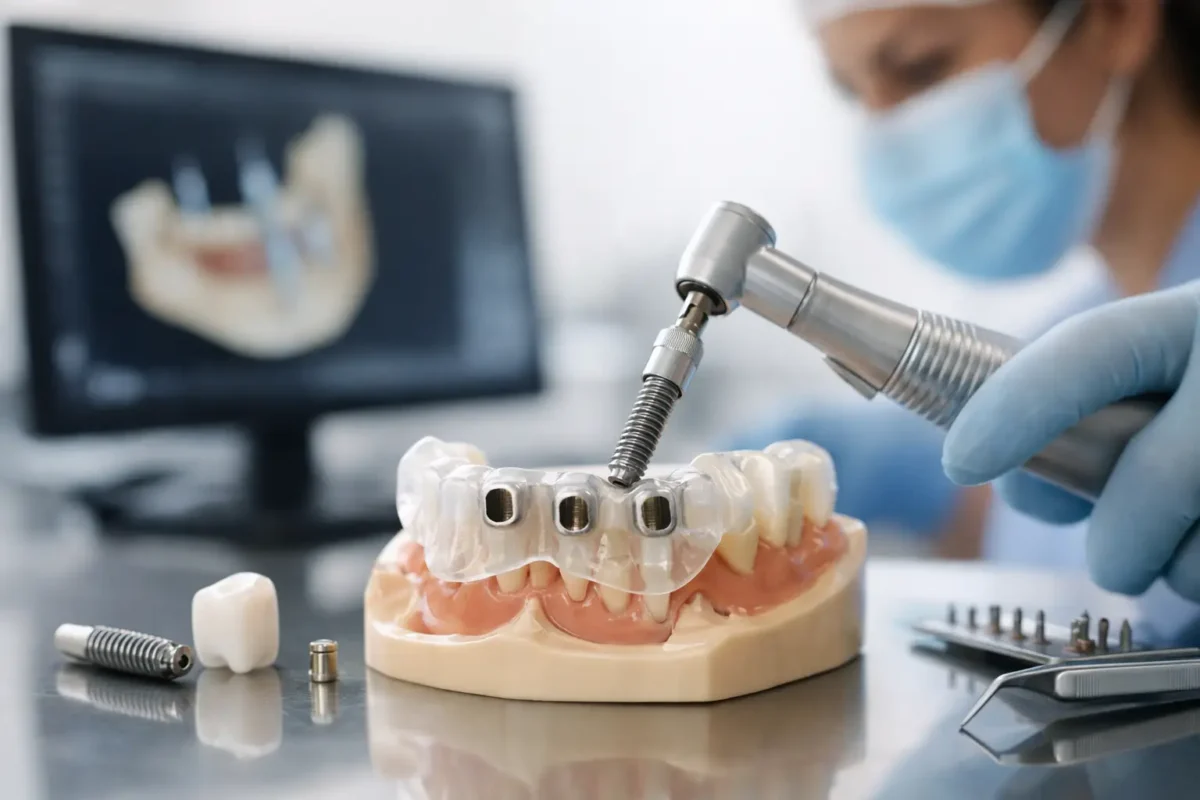
When a patient hears that an implant can be placed with a digital guide, the first question is usually simple: como funciona implante guiado in real life, and what difference does it actually make? The short answer is that guided implant surgery uses detailed 3D planning and a custom-made guide to help the dentist place the implant in the planned position with a high level of accuracy. The longer answer matters more, because this approach can affect comfort, timing, healing, and the predictability of the final result.
What guided implant surgery really means
A dental implant is a small titanium post placed in the jawbone to replace the root of a missing tooth. In traditional implant placement, the dentist plans the position using exams and imaging, then places the implant freehand during surgery. That method can work very well in experienced hands, but guided implant surgery adds another layer of control.
With a guided approach, the implant position is planned digitally before the procedure. The dentist uses a 3D scan of the jaw, often combined with digital impressions or an intraoral scan, to study the bone, gums, nearby teeth, and important structures such as nerves or the sinus. Based on that information, a surgical guide is created. This guide fits over the teeth or gums and directs the implant into the planned position during treatment.
So if you are asking how guided implants work, the key idea is this: the surgery begins on a computer before it begins in the mouth.
Como funciona implante guiado step by step
1. Assessment and imaging
The process starts with a consultation, clinical exam, and imaging. A 3D CBCT scan gives a detailed view of the jawbone, including bone width, bone height, and the location of nearby anatomical structures. This is one of the biggest advantages over relying on standard 2D X-rays alone.
Your dentist also checks the condition of the gums, bite, neighboring teeth, and overall oral health. If there is active gum disease, untreated decay, or insufficient bone, those issues may need to be addressed first. Guided surgery improves planning, but it does not remove the need for a proper diagnosis.
2. Digital treatment planning
Once the imaging is available, the implant is planned digitally. This is not just about finding a place where the implant fits in the bone. It is also about designing the position around the future tooth.
That distinction is important. A well-planned implant should support a crown that looks natural, feels stable, and is easy to clean. The angle, depth, and exact position all matter. If an implant is placed in a way that only works for the bone but not for the final tooth, the cosmetic and functional result can suffer.
This is why digital planning is so valuable. It allows the dentist to work backward from the ideal restorative result and then place the implant accordingly, within the limits of the available bone and anatomy.
3. Fabrication of the surgical guide
After planning, a custom guide is produced. This guide is designed for your mouth specifically. During the procedure, it helps control the location, angulation, and sometimes even the depth of the implant drills and the implant itself.
Think of it as a highly precise template rather than a generic tool. It does not replace clinical judgment, but it helps transfer the digital plan to the actual surgery with more consistency.
4. Implant placement
On the day of treatment, the guide is positioned in the mouth. Once it is stable, the dentist uses it to prepare the implant site and place the implant according to the digital plan.
In some cases, guided surgery can be performed with a minimally invasive approach, meaning smaller incisions or, in selected patients, no traditional flap at all. That can lead to less swelling, less discomfort, and faster healing. Still, this depends on the clinical situation. Not every case is suitable for the least invasive technique.
5. Healing and restoration
After placement, the implant needs time to integrate with the bone. This process is called osseointegration. Depending on the case, the final crown may be placed later, or a temporary tooth may be provided sooner.
Some patients are candidates for immediate or same-day solutions, but that depends on stability, bite forces, bone quality, and the location of the implant. It is a useful option in the right case, but it is not a promise that applies to everyone.
Why patients choose a guided approach
The biggest benefit is precision. Because the implant is planned in 3D and transferred using a custom guide, placement can often be more accurate than relying on visual estimation alone. That matters for both safety and aesthetics.
It can also make treatment feel more comfortable. When surgery is carefully planned in advance, the procedure is often more efficient. In some situations, less manipulation of the gum tissue is needed, which may reduce post-operative soreness and swelling.
Another advantage is communication. Guided implant planning makes it easier to show patients what is being proposed and why. For many international patients or anyone who values clarity, seeing the treatment plan visually can reduce uncertainty and make decision-making easier.
When guided implant surgery is especially useful
Guided techniques can be helpful in many implant cases, but they are particularly valuable when precision is critical. That includes implants in the front of the mouth, where aesthetics matter most, and cases near anatomical structures such as the sinus or nerve canal.
They are also useful in full-arch rehabilitation, multiple implant cases, and same-day implant workflows where planning has to account for both surgery and the temporary restoration. When several variables need to line up, digital guidance can make the process more predictable.
For busy professionals and international patients in Barcelona, there is another practical advantage: better planning often means fewer surprises. That can be helpful when trying to coordinate consultations, surgery, and restoration around work or travel.
Are guided implants always better?
Not automatically. Guided surgery is an excellent tool, but the quality of the result still depends on the quality of the diagnosis, planning, and execution. A guide is only as good as the information used to create it.
There are also cases where a highly experienced clinician may adjust the approach during treatment based on what they find clinically. Real anatomy does not always behave exactly like a digital model. That is why guided surgery should be seen as part of expert care, not a substitute for it.
Cost can also differ. Guided implant surgery may involve additional imaging, software planning, and guide fabrication, which can increase the fee compared with a simpler freehand case. For many patients, the added precision and confidence are worth it. Still, the right choice depends on the complexity of the case and the goals of treatment.
What recovery is usually like
Recovery varies from person to person, but many patients find guided implant surgery manageable. If the procedure is minimally invasive, there may be less swelling and tenderness than expected. Most people return to normal daily activities quickly, although strenuous exercise and certain foods may need to be avoided for a short period.
You may be given instructions about oral hygiene, medication, and follow-up visits. Following these closely matters just as much as the surgery itself. Even the best-planned implant needs a healthy healing environment and good long-term maintenance.
Questions worth asking before treatment
If you are considering implants, it helps to ask how your case will be planned, whether a CBCT scan is needed, whether guided surgery is recommended, and why. You can also ask whether you are a candidate for immediate restoration, how long the overall process may take, and what factors could change the timeline.
A good implant consultation should feel clear, not rushed. You should understand the benefits, the limitations, the expected healing period, and the costs before you commit. At clinics such as The British Dental Clinic, this kind of transparency is often just as reassuring as the technology itself.
Como funciona implante guiado for the patient experience
From a patient perspective, guided implant treatment is not just about software and scans. It is about making a complex procedure more understandable and more controlled. You know where the implant is planned to go, why that position was chosen, and how the surgical guide helps carry out that plan.
That can make the whole process feel less intimidating. For patients who have postponed treatment because they were nervous, unsure, or worried about miscommunication, a guided workflow often brings a greater sense of confidence.
If you are missing a tooth and want a solution that combines advanced planning with a more predictable path to the final result, guided implants are worth discussing. The technology matters, but the real value is what it gives you: a treatment plan built around precision, comfort, and trust.