Periodontal Surgery Recovery Time Explained
junio 5, 2026
Same Day Dental Implants Barcelona Guide
junio 7, 2026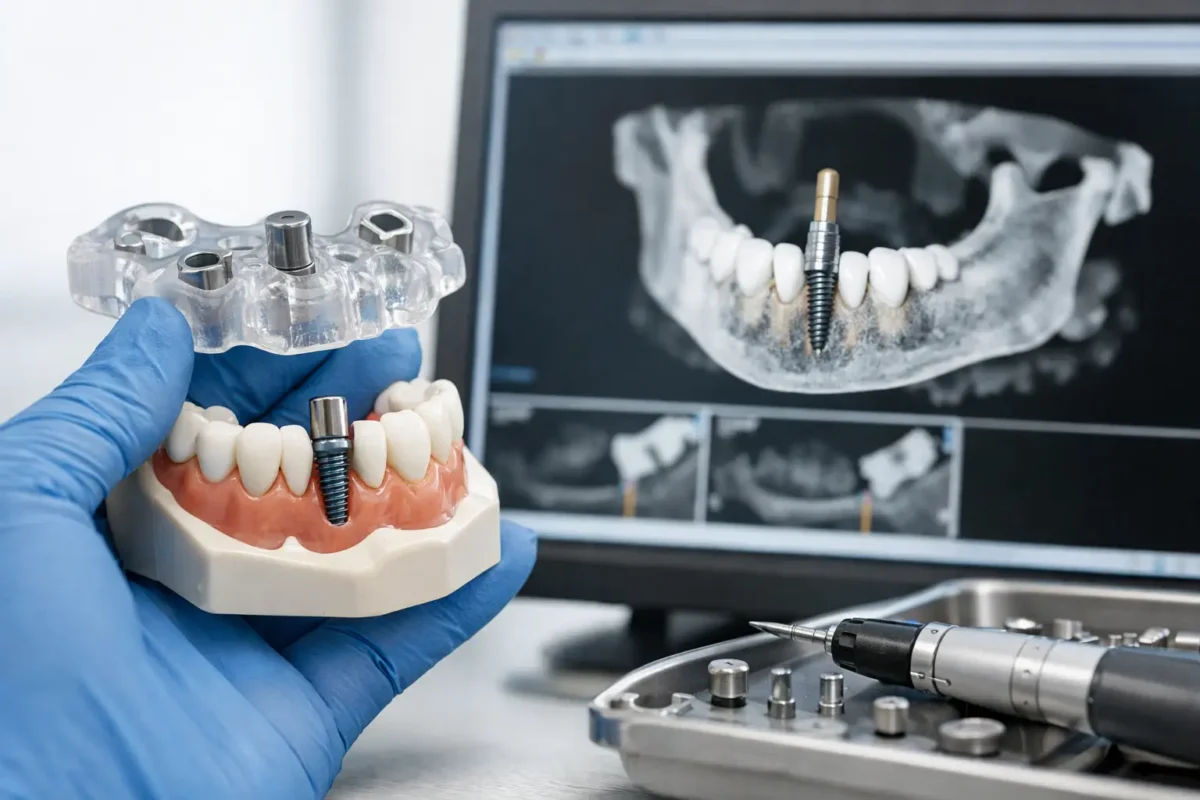
Losing a tooth changes more than your smile. It affects how you chew, how you speak, and often how confident you feel in everyday moments. Guided dental implant surgery is designed to make replacing missing teeth more precise, more predictable, and easier to plan from the very beginning.
For many patients, the biggest concern is not the implant itself. It is uncertainty. Will the treatment be painful? How long will it take? Will the final tooth look natural? A guided approach helps answer those questions before surgery even begins, because much of the work is done through careful digital planning rather than decisions made only in the chair.
What guided dental implant surgery means
Guided dental implant surgery uses digital scans, 3D imaging, and specialized planning software to map the exact position of a dental implant before treatment. Based on that plan, a custom surgical guide is created to help the dentist place the implant in the intended location, angle, and depth.
In simple terms, it is a more controlled way to perform implant surgery. Instead of relying only on what can be seen during the procedure, your dentist can evaluate the bone, surrounding teeth, bite, and restorative goals in advance. That planning matters because a dental implant is not placed in isolation. It has to support a future crown, fit comfortably in your bite, and sit in a position that looks natural when you smile.
This is one reason guided treatment appeals to busy international patients. It supports clearer communication, more transparent planning, and fewer surprises along the way.
Why precision matters in implant treatment
Dental implants need strong support from the jawbone, but they also need to work well with the visible part of the restoration. If an implant is placed too far forward, too deep, or at the wrong angle, the final crown may be harder to restore beautifully and comfortably.
Guided surgery helps reduce that risk by planning the implant position around the final result, not just the available bone. That is a subtle but important difference. A successful implant is not only one that integrates with the bone. It is one that also supports function, comfort, and esthetics over time.
That said, technology is not a substitute for clinical judgment. Good outcomes still depend on the dentist’s experience, the quality of the scan data, and a treatment plan tailored to the individual patient. Guided surgery improves control, but it is most effective when paired with careful case selection and realistic expectations.
How guided dental implant surgery is planned
The process usually starts with a consultation, clinical examination, and digital imaging. This may include 3D scans of the jaw and digital impressions or intraoral scans of the teeth and gums. These records allow your dentist to assess bone volume, nearby anatomical structures, and the best position for the implant.
From there, the treatment is planned virtually. The dentist can evaluate where the implant should go based on both surgical and restorative needs. In some cases, this planning also helps determine whether bone grafting is advisable, whether immediate placement is possible, or whether a temporary tooth can be provided on the same day.
Once the plan is finalized, a surgical guide is fabricated. This guide fits over the teeth or gums and helps direct the implant placement according to the approved plan. The result is a procedure with a high level of consistency and a clearer roadmap from diagnosis to final restoration.
What patients usually notice on the day of surgery
From a patient perspective, guided implant surgery often feels more organized and less stressful than expected. Because the position has already been planned digitally, the appointment can be more efficient. In suitable cases, treatment may also be less invasive than traditional freehand surgery.
That can translate into practical benefits such as reduced time in the chair, less disruption to surrounding tissues, and a smoother recovery. Some patients experience less swelling or post-operative discomfort, although this depends on the complexity of the case, the condition of the bone and gums, and whether additional procedures are needed.
Not every implant case is simple. If there is significant bone loss, active gum disease, or multiple missing teeth, treatment may still involve staged care. Guided surgery helps in these situations too, but the timeline and healing process can be more involved.
Who is a good candidate for guided implant surgery
Many adults missing one tooth, several teeth, or even a full arch can benefit from guided implant treatment. It is especially useful when precision is critical, when the case has esthetic demands, or when patients want a clearer understanding of the process before committing to treatment.
You may be a strong candidate if your mouth is otherwise healthy or can be stabilized first. Healthy gums, good oral hygiene, and adequate bone support all improve the chances of long-term success. If bone volume is limited, that does not automatically rule out implants, but it may mean that grafting or a modified treatment plan is recommended.
Smoking, uncontrolled diabetes, untreated periodontal disease, and certain bite issues can affect healing and outcomes. These are not details to overlook. A trustworthy implant consultation should include a frank discussion of risks, alternatives, costs, and timing.
The benefits and the trade-offs
The main advantage of guided surgery is accuracy. That supports better implant positioning, more confidence in treatment planning, and often a more comfortable patient experience. It can also improve efficiency when several parts of the treatment are coordinated digitally.
Another benefit is communication. For patients who have had confusing or rushed dental experiences in the past, seeing a treatment plan explained clearly on screen can make the process feel far more understandable. You are not just being told what will happen. You are being shown how and why those decisions are made.
Still, guided implant surgery is not automatically the right solution in every situation. It requires detailed diagnostics and planning, which can add cost and preparation time at the beginning. In a straightforward case, that extra planning may still be worthwhile, but the value depends on the patient’s anatomy, goals, and the complexity of the restoration.
There is also a misconception that guided surgery guarantees a perfect result. It does not. It improves predictability, but healing biology, home care, and long-term maintenance still matter just as much.
Recovery after guided dental implant surgery
Most patients can return to normal daily activities fairly quickly, often within a day or two depending on the procedure. Mild soreness, swelling, or tenderness is common in the early healing phase. Your dentist will usually recommend a soft diet for a short period and provide instructions for cleaning the area carefully.
Healing takes place in stages. Even if the surgery itself is efficient, the implant still needs time to integrate with the bone. In some cases, a temporary restoration can be placed early. In others, it is safer to wait before fitting the final crown. This depends on stability at placement, bite forces, and whether the implant is in a visible area.
Follow-up matters. Implant treatment does not end once the implant is placed. Regular reviews help confirm healing is progressing as expected and allow the final restoration to be adjusted for comfort, function, and esthetics.
Choosing a clinic for guided implant care
If you are comparing options, look beyond the phrase guided surgery itself. Ask how the planning is done, what imaging is used, who designs the final restoration, and how the team explains alternatives if your case is not ideal for immediate treatment.
Good implant care should feel structured and transparent. You should understand the sequence of treatment, the expected timeline, the likely costs, and what could change if healing does not go exactly to plan. For international patients in particular, clear communication is not a luxury. It is part of safe care.
At a clinic such as The British Dental Clinic in Barcelona, this matters because patients often want both advanced treatment and straightforward explanations in English. That combination can make a complex procedure feel much more manageable.
If you are considering implants, guided treatment is worth asking about not because it sounds more advanced, but because it can make the whole process more precise, more understandable, and more personalized. The right plan is the one that fits your health, your goals, and your life – and you should feel confident in it before treatment even begins.