
8 Best Habits for Healthier Gums That Work
noviembre 1, 2026
Caso Implante Carga Inmediata: Patient Results
noviembre 5, 2026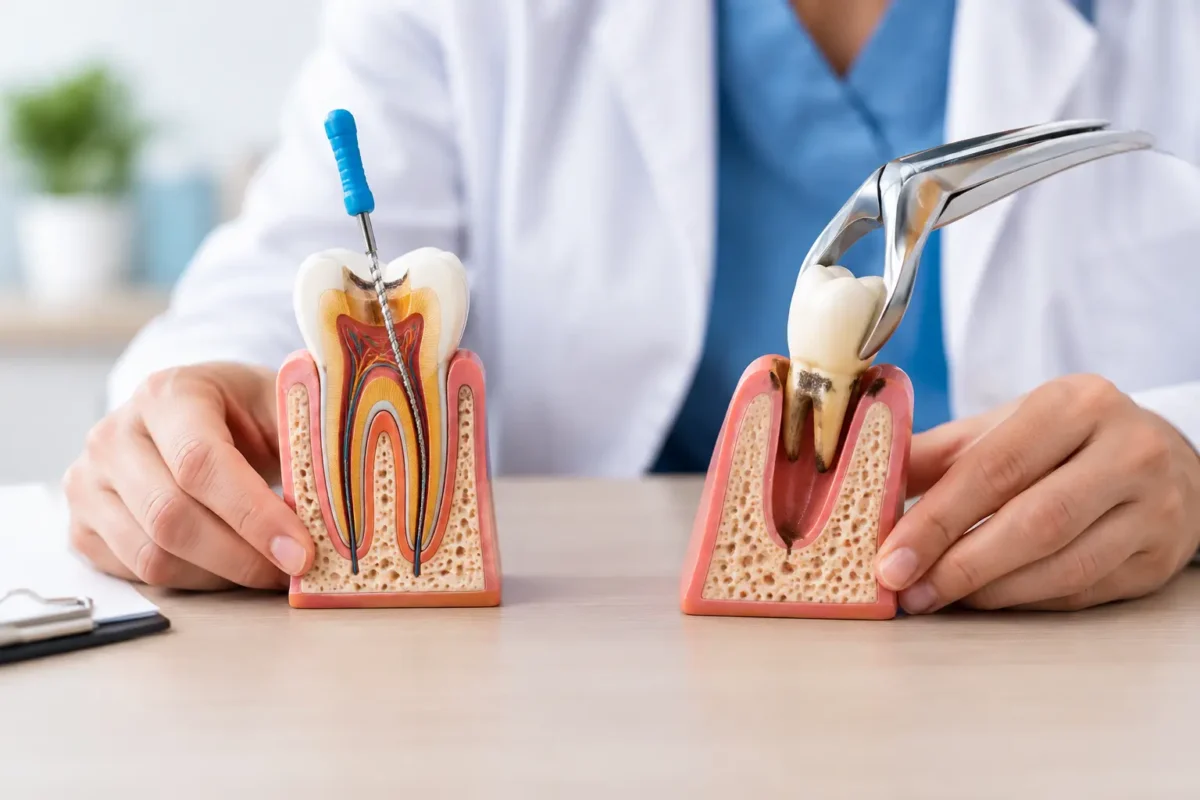
A badly damaged or infected tooth can make even a simple meal feel stressful. When your dentist presents root canal versus extraction as the two main options, the right decision is rarely about choosing the quickest treatment. It is about protecting your health, comfort, appearance, budget, and long-term ability to chew confidently.
Both treatments can stop pain and remove infection. The key difference is that root canal treatment aims to save your natural tooth, while extraction removes it completely. A careful examination, usually supported by digital X-rays, helps determine which option offers the most predictable result for your individual situation.
Root Canal Versus Extraction: The Core Difference
A root canal is recommended when the soft tissue inside a tooth, known as the pulp, is inflamed or infected. This may happen because of deep decay, a cracked tooth, repeated dental work, or an injury. During treatment, the dentist removes the infected tissue, cleans and disinfects the inside of the tooth, and seals it to prevent reinfection. In many cases, a crown is then placed to restore strength and appearance.
An extraction involves removing the entire tooth from the gum and jawbone. It may be the best choice when a tooth is too broken down to restore, has a severe fracture below the gumline, has advanced gum disease, or cannot be treated predictably with root canal therapy and a crown.
Neither treatment is automatically “better.” The question is whether the tooth can be saved with a strong long-term outlook, or whether removing it will protect your health and avoid repeated treatment.
When Saving the Tooth Makes Sense
Whenever possible, dentists generally prefer to retain a healthy natural tooth. Your own tooth is designed to work with your bite, support nearby teeth, and maintain the shape of your jaw. A successful root canal followed by an appropriate restoration can allow a tooth to function for many years.
Root canal treatment may be a strong option when there is enough healthy tooth structure above the gumline to support a filling or crown, the root is intact, and the supporting bone and gums are in good condition. It can also be especially valuable for visible front teeth, where preserving the natural tooth helps maintain a natural-looking smile.
Saving a tooth does require a commitment to follow-up care. A tooth that has had root canal treatment can become more brittle, particularly if it is a molar that absorbs heavy chewing forces. A custom crown often provides the protection needed to reduce the risk of future fracture.
Is a Root Canal Painful?
Modern root canal treatment is usually much more comfortable than people expect. The pain associated with an infected tooth often comes from the infection itself, not the procedure used to treat it. Local anesthesia numbs the area thoroughly, and the dentist works carefully to keep you comfortable throughout the appointment.
It is normal to have some tenderness for a few days afterward, especially if the tooth was very inflamed before treatment. This is usually manageable with the advice and medication recommended by your dentist. If dental anxiety has made you delay care, sharing that concern early allows the team to plan a calmer, more comfortable experience.
When Extraction May Be the Better Choice
There are times when trying to save a tooth creates more risk, cost, and uncertainty than it is worth. An extraction may be recommended if decay extends too far below the gumline, the tooth has a vertical root fracture, or there is not enough solid structure remaining to hold a crown securely.
Severe periodontal disease can also make extraction the sensible choice. If the bone and gums no longer provide stable support, even a technically successful root canal may not give the tooth a reliable future. In these situations, removing the tooth can eliminate ongoing infection and create a clean foundation for a replacement option.
Extraction is sometimes faster and may have a lower upfront cost than root canal treatment plus a crown. However, the immediate price does not always reflect the full long-term picture. Unless the missing tooth is a wisdom tooth or in a position where replacement is unnecessary, you should also consider how to restore the space.
The Long-Term Impact of a Missing Tooth
Leaving a gap after an extraction can affect more than appearance. Nearby teeth may gradually shift toward the space, changing your bite and making cleaning more difficult. The opposing tooth can also move out of position over time because it no longer has a tooth to bite against.
The jawbone in the area of an extracted tooth may slowly lose volume because it is no longer stimulated by chewing forces. This can be particularly relevant in the smile zone and for patients considering an implant later. Replacing a missing tooth sooner can often make treatment planning more straightforward.
Common replacement options include a dental implant with a crown, a bridge supported by neighboring teeth, or a removable partial denture. An implant is often the closest replacement for a natural tooth because it replaces the root as well as the visible crown. It is not right for every patient, but guided implant planning can make the process highly precise where it is suitable.
Comparing Treatment Time and Recovery
A straightforward extraction may take one appointment, followed by a healing period. Root canal treatment may be completed in one or more visits, depending on the tooth and the extent of infection. If a crown is needed, there is an additional restorative stage.
The timeline becomes more complex after extraction if you choose to replace the tooth. Implant treatment can involve healing time before the final crown is placed, although some patients may be candidates for immediate or same-day solutions. A bridge can often be completed more quickly, but it requires treatment of the adjacent teeth.
Recovery also depends on the individual. After an extraction, patients may experience swelling, tenderness, and dietary limitations for several days. Following a root canal, most people return to normal routines quickly, although they should avoid chewing heavily on the treated tooth until it has been fully restored.
Cost: Look Beyond the First Appointment
It is understandable to compare the cost of root canal treatment with the cost of an extraction. An extraction is often less expensive at the outset. Yet if the tooth needs replacement, the total investment can be higher than saving the tooth, particularly when an implant and crown are involved.
A clear treatment plan should explain the anticipated stages, fees, alternatives, and expected longevity of each option. It should also be honest about uncertainty. For example, a heavily damaged tooth may be technically treatable but carry a guarded prognosis. In that case, choosing extraction and a replacement may offer more predictability.
At The British Dental Clinic, treatment recommendations are based on a detailed assessment of the tooth, gums, bite, and your personal priorities. For international patients in Barcelona, having these choices explained clearly in English can make a difficult decision feel far more manageable.
Questions Worth Asking Before You Decide
A good consultation should leave you with practical answers, not pressure. Ask whether the tooth is restorable, how likely each treatment is to succeed, and what happens if the chosen treatment does not work as planned. You may also want to ask whether a crown is needed after a root canal and which replacement options are appropriate if extraction is recommended.
Your lifestyle matters too. If you are traveling frequently, have an important event approaching, or want to minimize the number of appointments, tell your dentist. These details can influence the timing and sequence of care without compromising clinical quality.
If you have facial swelling, fever, difficulty swallowing, or pain that is rapidly worsening, seek urgent dental assessment. Dental infections do not reliably resolve on their own and can become more serious when treatment is delayed.
The best choice is the one that treats the problem thoroughly while giving you a result you can trust. With a clear diagnosis and a conversation that respects your concerns, you can move forward knowing exactly why a root canal or extraction has been recommended.